* You are viewing the archive for the ‘Business’ Category

The Belgian Video Game Industry

Citing this Wikipedia article, Belgium is famous for beer, chocolate, waffles and french fries with mayonnaise.
As a team based in Belgium, we certainly couldn’t agree more!

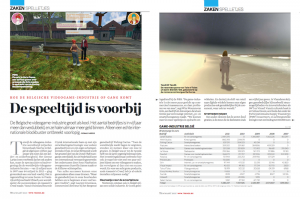
Less well known is the fact that Belgium also has a small but growing games industry. This didn’t go unnoticed by the financial and economical magazine Trends, as they published an article about the state of the industry.

Click to view the PDF version of the full article in Dutch.

Click to view the PDF version of the full article in Dutch.
Kudos to Trends for providing the PDF!

Since the article was written in Dutch, I’ve summarized it for you:

  • The Belgian game industry has been (and still is) a lot smaller than in most neighboring countries.
  • Mobile games, social games, advergames and serious games: the game industry has been diversifying during the last couple of years.
  • At the same time, the Belgian game industry started to grow. From 7 companies in 2007 to 15 companies in 2011, and a few more since. This means an increase in revenue from about 1.3 million euro to about 4.5 million.
  • Both in Flanders and Wallonia, there is some government support – including subsidies for specific projects and cheap loans. However, some say a tax cut for the entire Belgian game industry would be a more fair measure.
Graph based on the article. Not all companies are included in the numbers, but it does give a sense of the growth.

Graph based on the article. Not all companies are included in the numbers, but it does give a sense of the growth.
Note that I applied a small correction to the numbers, by distributing the revenue of the biggest player over two years, as they extended their financial year.

Game Connection Europe 2012

PreviewLabs is currently present at Game Connection 2012 in Paris. Just like last time we went in 2010, we’re aiming to expand our network by meeting new people and companies in the industry. This time featuring a bigger portfolio: over 45 projects done in the first three years of our existence!

20121128-215815.jpg

During the event, I’ll be taking some pictures now and then, and sharing them on our Facebook page.

ActiveCollab 3.0 Timer Issue: Resolved

With the recent growth of the company, we’re now focusing on improving the scaleability of our team – to allow further growth. As a part of this effort, we’ve been trying out several solutions for time tracking and project management.

Currently, we’re doing a trial with ActiveCollab, a web based project management solution, which allows sharing specific pieces of information (such as a prototype estimation breakdown) in an elegant manner.

In combination with ActiveCollab, we’ve been using the ActiveCollab Timer application, to allow us to continue tracking time, even when the Internet connection or ActiveCollab hosting would be down.

Due to an automatic upgrade to ActiveCollab 3.0, which happened yesterday evening, the Timer application ceased working, and some timer entries were stick in the sending queue (not visible any more in the application, nor sent and stored in the web based system). After contacting ActiveCollab Support, it seemed that there would be no way to recover the lost data.

Luckily, we’ve found that you can read this data from a file on your disk.

This is what you need to do in case you’d need to recover this lost data:

  • Download SQLite Database Browser.
  • Use it to open the file activeCollabTimer.db in the ~/Library/Application Support/A51/activeCollabTimer directory (Windows users can search for the activeCollabTimer.db file to locate it).
  • You’ll see that the data you’re looking for is stored in the actimesubmit_time column of the actimesubmit table (as it can be seen in the screenshot).

The Festival of Games 2012

For the third time in a row, we’ll be attending the Festival of Games event in Utrecht, the Netherlands.

The #FoG12 is a small game industry event, were the key players of the Dutch games industry can be met, as well as companies from other countries interested in meeting these players (such as ourselves – PreviewLabs).

There’s also a conference part to it – this time appealingly called the Creative Spirit Game Conference 2012, but I’m mainly attending for the networking opportunities.

If you’re attending the Festival of Games as well, and would like to learn more about what PreviewLabs is doing, please don’t hesitate and get in touch through our contact form!

Status Update

It’s been an extremely busy time lately, so I decided to give a quick bullet-point-style status update on PreviewLabs’ activity since the previous blog post:

  • We delivered our first Unity3D + Kinect prototype for Yale University a few weeks ago. More specifically, this was developed for the Yale Child Study Center at the Yale School of Medicine. The prototype is currently being used for research purposes.
  • Last month, I attended the Game Developers Conference in San Francisco. This was a great occasion to meet some of the customers we’ve worked for before in real life for the very first time, and also to make new connections. Together with Kinection, we even used this unique occasion to work on some ongoing projects together for a few hours.
  • We’ve been brainstorming for Cartamundi – the world leader in playing cards – and developed a prototype for them showing off Printechnologic’s TouchCode API in combination with cards printed by Cartamundi. The prototype shows how this technology can enhance the gameplay.
  • The books of the Unity Essentials Books Giveaway found their way to their new owners. Enjoy!
  • After all the work done for Kinection, it’s no surprise that there would be more educational game prototyping projects coming up. The first one has been delivered just a week ago, for a client in Belgium. I’m starting to see more and more signs indicating that the market for serious games for educational purposes, used in schools, is something that will really kick of in the next years.
  • We’ve worked for our first customer in Hong Kong! And that’s pretty much all that can be disclosed about it at the moment…

3 Most Popular Posts of 2011 – and Other Website Statistics

Looking back at our Google Analytics statistics of 2011, here’s a quick overview of our website statistics.

First of all, here’s a top 3 of our most popular blog posts in 2011:

  1. File I/O in Unity3D (6117 pageviews)
  2. Writing PlayerPrefs Fast (4387 pageviews)
  3. Unity and Playmaker (1458 pageviews)

During 2011, there was a spectacular growth in number of page views and visitors: from 1157 pageviews and 233 visitors in January 2011 to 4861 page views and 2728 visitors in December 2011. This means the amount of page views quadrupled, and the amount of visitors increased by a factor of ten!

Graph with the amount of visitors (dark blue) and page views (light blue) on our website in 2011.

Most website visitors are from the United States, the country with the biggest game industry, while Belgium takes a second place, as the PreviewLabs team’s home country. It’s nice to see that we have visitors of so many different countries: 126 countries out of the about 196 countries in the world.

Visits per country

To end this article, Google tells us that 3.75% of our page views have been made on mobile devices. This is still quite small, but I’m curious to see how this will evolve over the course of 2012 – as the smartphone and tablet market is expected to grow…

Customer Testimonial: Pitching Video Game Ideas

If a game isn’t fun, it’s not worth playing.
If it isn’t meaningful, it’s not worth remembering.

Under this slogan, Nicolas Marinus of Thumbs Up Games went to the gamescom event to pitch several of his game concepts to major publishers. In order to stand out, he used prototypes we developed for him to tell his story.

This is what he wrote about his experiences pitching the concepts:

As a beginning developer, a lot of doors aren’t open to you. Getting through to publishers and investors is hard. Convincing them your idea is better than that of the competition even harder. Certainly if all you have is some text on a piece of paper.

That’s where that prototype in your pocket makes a world of difference. You get the opportunity to show the game, to let people play it.

As someone from Big Fish whom I met at the gamescom said: “This is the first time this week I get to actually play a game”.

My strategy was simple: I would walk straight past the girls at the counter and up to the first person wearing a badge from the publisher and introduce myself. “Hi, I have this prototype I really want to show someone (meanwhile I was flicking through some artwork on my iPhone), would you be the right person to talk to?”. When I found the right person, the response would generally be “You have 10 minutes”.

Concept art by Stijn Vandoorselaere, used by Thumbs Up Games to accompany the prototype for Penguin Revolution.

I learned to pitch and show two prototypes in under 5 minutes. And you know what? Most meetings turned out to last a lot longer. Partly because they liked the ideas, partly because they got to see those ideas in action.

Before attending the gamescom, my main challenge was to find a partner. Now, the challenge is to decide which partner would be best suited for me. And that’s one luxury I love to have.

GDC Europe 2011: Day 1

Yesterday was the first day of the GDC Europe. Together with the gamescom (held in the same week), this is the biggest gathering of game developers, publishers and gamers on the European continent.

PreviewLabs will be available for business meetings and networking at both the GDC and the gamescom events.

Among the many speakers, there was Enric Alvarez of Mercury Steam, detailing on the development of Castlevania – Lords of Shadow.

A feature they wanted from the very start of the project was the ability to battle Titans – very huge boss-style enemies.

At first, the team was tempted to use quick-time events for these boss battles. During these quick-time events, the player would have to repeatedly press certain button combinations, in order to see an animation where the enemy gets defeated. This would make the implementation easy – offering less exciting gameplay, but still an elegant solution. After all, the actual battle against these Titans wasn’t essential for this hack and slash game.

Finally, they ended up prototyping this part of the game. The results of this were very satisfactory, so this part of the gameplay became one of the unique selling points of the game.

This shows how prototyping can not only help you to get the core mechanics right; it can also be useful for the more technically challenging parts of a game.

PreviewLabs @ E3 next week!

Hi! My name is Chris Foley, I’m a biz dev/sales guy for PreviewLabs and for my inaugural post I’m letting everyone know that PreviewLabs will be at E3 in Los Angeles, California next week!

All the major publishers will be at E3, and if you’re interested in finding a publisher, PreviewLabs can help bring your game design to life. Whether it’s putting together a playable demo to accompany your design documents, pitching new game mechanics internally, or simply using prototypes as part of your development cycle, PreviewLabs can flesh out your game ideas and designs and demonstrate to everyone exactly how great your game really is.

PreviewLabs’ Rapid Game Prototyping service is great for established studios too! We can lower your production costs, reduce risk and uncertainty in your project management, and create a more efficient development cycle.

If you’re going to be at E3 next week I’d love to meet personally and chat about PreviewLabs, game development, or just share industry gossip! :) Just send me a message through the contact form or give me a call at +1 (949) 413-1074.

See you there!

@PreviewLabs

Check out a cartoon we posted on our brand new Twitter account!

Now follow us on Twitter to stay tuned with short newsflashes, and perhaps even promotions!

123